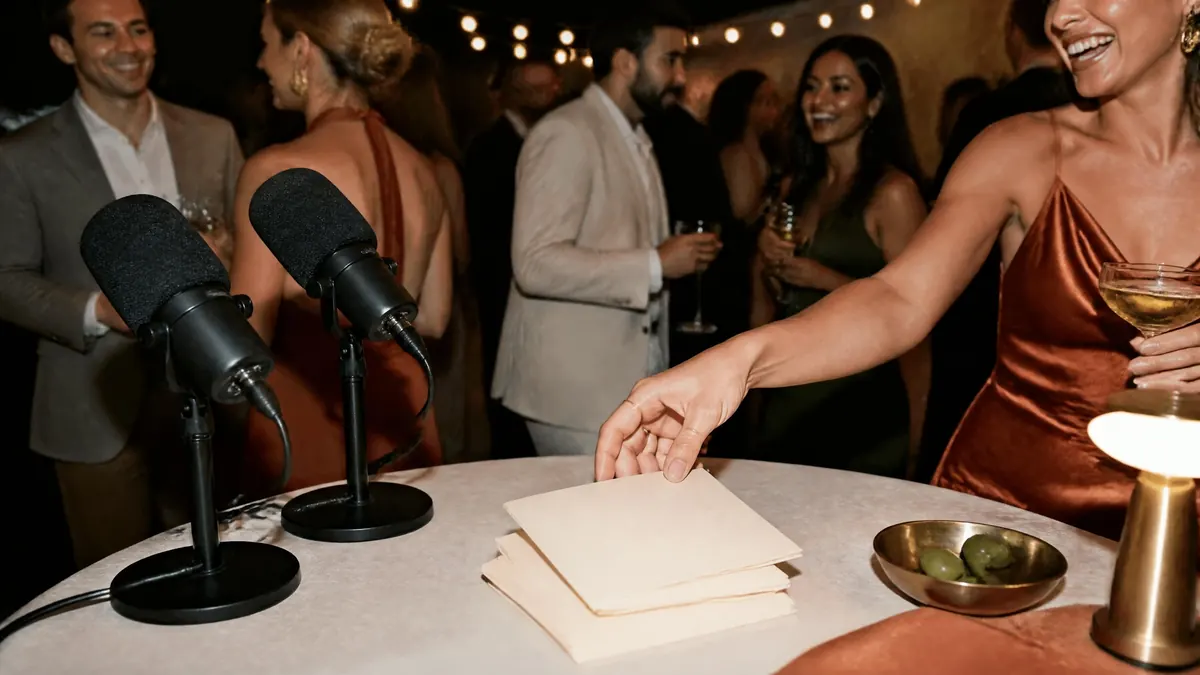
A card that says be funny is how you get a stiff thirty seconds and a joke that dies. I host the two-microphone table. Wedding podcast questions that get real stories ask for a scene two people already share: a meeting, a trip, a kitchen, a dare about later. Write the job of each card in one line, keep four doors, and throw out the landmines before the night.
A table often hears a real voice when the card asks what happened, not who is the kindest. The guest can ignore the card and just talk. Four scenes beat twenty quiz lines. Nobody named here.
- Write the job of the card in one line.
- Prefer scene prompts over adjective prompts.
- Keep four cards: meeting, travel, kitchen, future dare.
- Cut prompts that accidentally start a roast.
- Write cards in the languages people will actually speak.
- Skip exes, fertility, and money.
- Review the list with the couple and the planner.
How mouths open is in how to get wedding guests talking on camera. The short landing is how it works. This page is the card: what to write, what to skip, how a planner signs it off.
Write the job of the card in one line
The card is not a quiz. It is a first sentence for two people who already know they can talk. One line. That is the whole job.
The pattern looks like this. A blank card asks for a speech. A long card asks for homework. A one-line job asks for a scene. "Tell the kitchen story" is a job. "Leave a beautiful, heartfelt, unique message for the couple" is a paragraph nobody wants to start.
Booth lists often say pick three or four. Digital guides say three to five, because a long menu feels like school. We are two chairs and a talk. Four jobs plus one "ignore this and talk" card is enough.
A table often hears the plus-one who only met the couple at the Barcelona airport. A childhood card freezes them. "How did you get here today" gives them a scene.
Recommendation: write the job first, then the wording. If you cannot say the job in one line, the card is not ready.
Scene prompts beat adjective prompts
A toast asks for a performance. An adjective prompt asks for a review. A scene prompt asks what happened. Wedding podcast questions work when they sound like a friend, not a hiring panel.
I have heard the adjective card more than once. Three words. Kind. Hardworking. Generous. Then a thank you for the opportunity. Nobody named here. The guest is not rude. The card asked for a resume.
| Prompt shape | What you get | Use it? |
|---|---|---|
| Be funny now | Panic, then a joke that dies | No |
| Describe them in three words | Kind. Generous. Next. | No |
| Any message / say whatever you want | Lots of love. A pause. A shrug | No |
| Tell the first time you saw them in a kitchen | A scene two people can share | Yes |
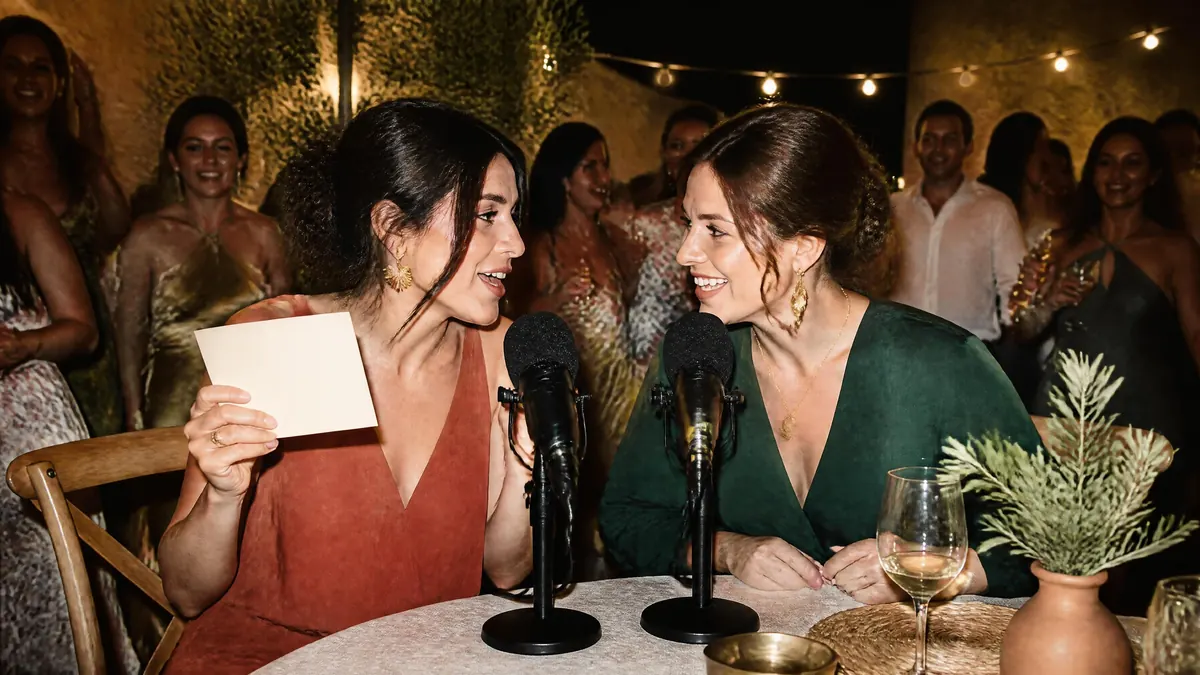
Advice and a ten-year guess show up on almost every vendor list. Fine as a backup. Weak as the only card. Advice turns some guests into consultants. A scene keeps them in the room they already lived. If a prompt can be answered with an adjective, rewrite it until it needs a place or a small thing that happened.
Checklist: meeting story, travel story, kitchen story, future dare
You do not need twenty questions. You need four doors. Most guests can walk through one of them. The rest can ignore the card.
- Meeting story. The first time you saw them in the same room. Not "how did you meet" as a form. The doorway, the noise, the stupid detail.
- Travel story. The trip that went wrong and then right. Destination lists are full of these. Someone flew. Someone got lost. Someone still tells it.
- Kitchen story. The small ordinary thing: a dinner, a mess, a song in another room. Kitchens make shy people specific.
- Future dare. One warm dare about later. Not a fertility plan. A restaurant they should try. A habit they should not drop. A trip they already joke about.

Useful shapes, not a sacred list from a named shoot. "Tell the meeting story from the doorway." "Tell the travel story you still argue about." "Tell the kitchen story." "Dare them to keep one small thing."
On practice, one outgoing friend sits first and picks the kitchen card. The next pair hears that nobody is being grilled. The plus-one picks travel or future, not childhood.
Recommendation: print four cards. Leave a fifth that says they can ignore all of them and just talk. Do not add a "be hilarious" card to fill the tray.
Prompts that accidentally start a roast
Funny is not the enemy. Roast-bait is. A "share a funny story" card sounds harmless on a booth list. At a two-mic table it can become a set already tested on the group chat.
The pattern looks like this. The card asks for the story they hope we forgot, or the thing they should never do. Someone laughs. Someone else goes sharper. A table often hears the joke about a parent that needed a room, not a file.
A roast that needs an audience should not become the keepsake. I pause and ask for the story under the joke. If it is only heat, we stand up. Dirty lines about relatives do not belong on a video the couple will open in ten years.
Prompts can be warm-funny. "The travel story you still argue about" is funny because it is true. "Destroy them" is a roast wearing a smile.
Recommendation: cut any card whose easiest answer is a punchline about a relative. Brief the wedding party once: memories, not a second speech.
Multilingual cards without fake "we host in 8 languages"
Destination dinners in Spain mix English and Spanish in one sentence. Sometimes a third language at one table and not at the next. Guests should speak as they speak. I do not translate every line like a stand-up act.
We will not list eight languages as a service fact. Prompt languages are confirmed when you inquire. The honest move is smaller: write the cards in the languages the room will actually use. If the dinner is English and Spanish, print both. One job, two wordings, same scene.
A bilingual sign that says "leave a message / deja un mensaje" is still a blank ask. Translate the scene. "Tell the kitchen story / Contad la historia de la cocina." The cousin who thinks in Spanish does not have to perform in English for the mic.
Recommendation: tell us what the room will use. Write those cards. Do not print a flag row to look international.
What to skip (exes, fertility, money)
Icebreaker guides keep a short skip list: past relationships, money, politics, family drama. On a recorded two-mic table the same mines last longer, because the file lasts.
Skip exes. "When did you know they were over their ex" is a trap you handed to an uncle with a drink.
Skip fertility. A future dare is a restaurant or a habit, not "when are the babies" and not a joke about who cannot have them. Private-life questions do not become cute on cream card.
Skip money. Who pays, what the wedding cost, who married well. Guests will go there if you open the door.
Also skip "say whatever you want" as the only line. A blank permission can feel like a deposition. A small scene is kinder.
Recommendation: if you would not ask it at dinner in front of both families, do not print it for the camera.
How the couple reviews the list with the planner
The couple knows which story is tender. The planner knows who will sit and which plus-ones barely know the names. Review the list together. One short pass. Not a committee.
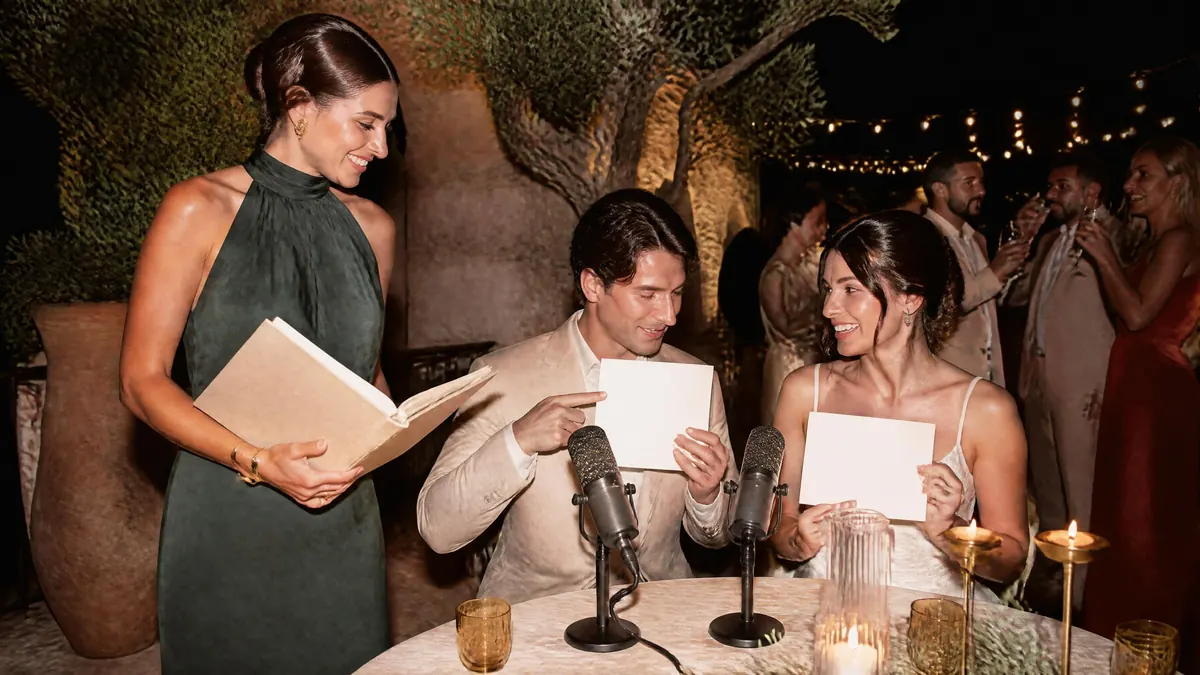
Walk the four cards. Mark the one that is too inside for a plus-one. Mark the one that will pull a roast. Add the ignore line. Write the languages.
Planners already send date, venue, languages, and a timing window when they check a date. The card stack belongs in that same note. The planner path is for wedding planners. If the date is the question, use Check availability with the venue and the languages the room will actually speak.
Sitting down is voluntary. Recordings are for the couple. Posting a face later is a separate yes.
Recommendation: one page, four cards, two people who should sit first. If you need a second page, you wrote a quiz.
What to do next
- Write the job of each card in one line.
- Keep meeting, travel, kitchen, future dare.
- Cut roast-bait, exes, fertility, and money.
- Print the cards in the languages people will use.
- Send the stack through Check availability, or message WhatsApp if the date is close.
The mechanic is small on purpose. Two mics. Two chairs. A card that asks for a scene. That is how wedding podcast questions get real stories when the night is already loud.
Frequently asked questions
How many wedding podcast questions should we write?
Four scene cards plus one that says they can ignore the card. Booth lists often pick three or four. A longer tray starts to feel like homework.
Can guests ignore the card?
Yes. Print that permission. Sitting down is already voluntary. A card is a first sentence, not a script they must finish.
Should the prompts be funny?
Warm-funny is fine. Roast-bait is not. Ask for a travel story they still argue about. Do not ask them to destroy anyone.
Do we need a different card for every guest?
No. Four doors are enough. Give plus-ones the travel or future card, not a childhood exam.
What if a prompt starts a roast?
Pause. Ask for the story under the joke. Stand up if it is only heat. Cut roast-bait cards before the day so you need that pause less.
Can we write cards in two languages?
Yes, if the room will use both. Same scene, two wordings. We will not claim eight host languages as a fact.
Who approves the list before the wedding?
The couple and the planner, in one short pass. The couple flags tender stories. The planner flags plus-ones and roast risk.