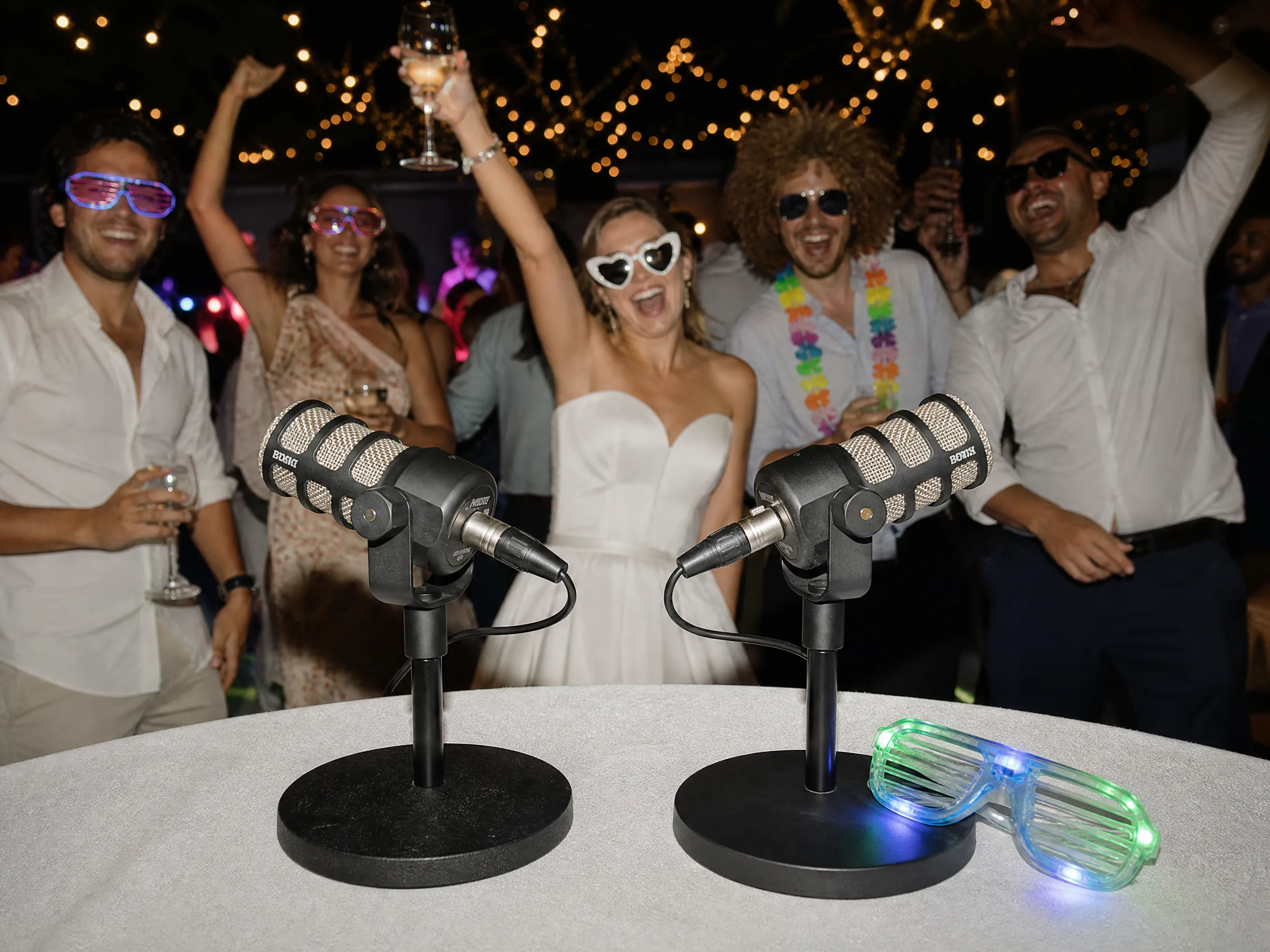
How a wedding podcast works is not a lesson in launching Spotify. At a destination wedding in Spain, guests sit at a designed two-microphone table, talk with simple prompts, and leave professionally recorded video and audio for the couple. Nobody is forced to perform. The setup is part of the room, not a remote studio. This guide walks the day from inquiry to the files you take home.
Search results will try to teach you boom arms and guest-prep emails. Ignore those for this hire. Wedding Podcast Spain is an on-site guest video-podcast. If you still need the category name, start with what a wedding podcast is, then come back to the steps.
We will not invent coverage hours, a staff count, or a delivery week. Those facts are not on the public brief. Share your timeline. We confirm what fits.
The short version
Day flow:
Check the date and venue → set languages and prompts → place the two-mic table → guests sit and talk → couple receives professionally recorded video and audio
- Share the wedding date, venue, and a WhatsApp contact so we can confirm the day.
- Agree where the table sits and which languages your guests actually speak.
- Prepare prompt cards that invite stories, not jokes from a comedy host.
- Let guests sit in pairs during cocktail, after dinner, or open bar.
- Take home professionally recorded video and audio of those conversations.
The landing page how it works keeps this sequence short. This article is the educational version: what people do, what they are not asked to do, and how this differs from starting a show.
Recommendation: send the five steps to your planner as a brief. If a sentence sounds like “we will publish episodes”, delete it.
Before the wedding: date, venue, languages, prompts
Before the wedding you only need facts the day cannot guess. Date and venue come first. A finca courtyard is not a hotel salon. Each room has wind, power, and a noise floor.
Languages come next. Destination lists mix English, Spanish, Catalan, and other home languages. Guests should speak as they speak. We will not list eight languages as a service fact. Tell us what people will actually use.
Prompts are a kindness. A blank camera makes some people freeze. A short question is a door. “Be funny now” is a trap.
Recommendation: write prompts with your planner in the languages of the room. Leave one card that says they can ignore it and just talk.
The table: two microphones, seating, camera and light as design
The wedding podcast setup is a small piece of furniture, not a stage. An elegant table. Two linen chairs. Exactly two professional broadcast-style microphones. A discreet camera and light that look like design, not a TV truck.
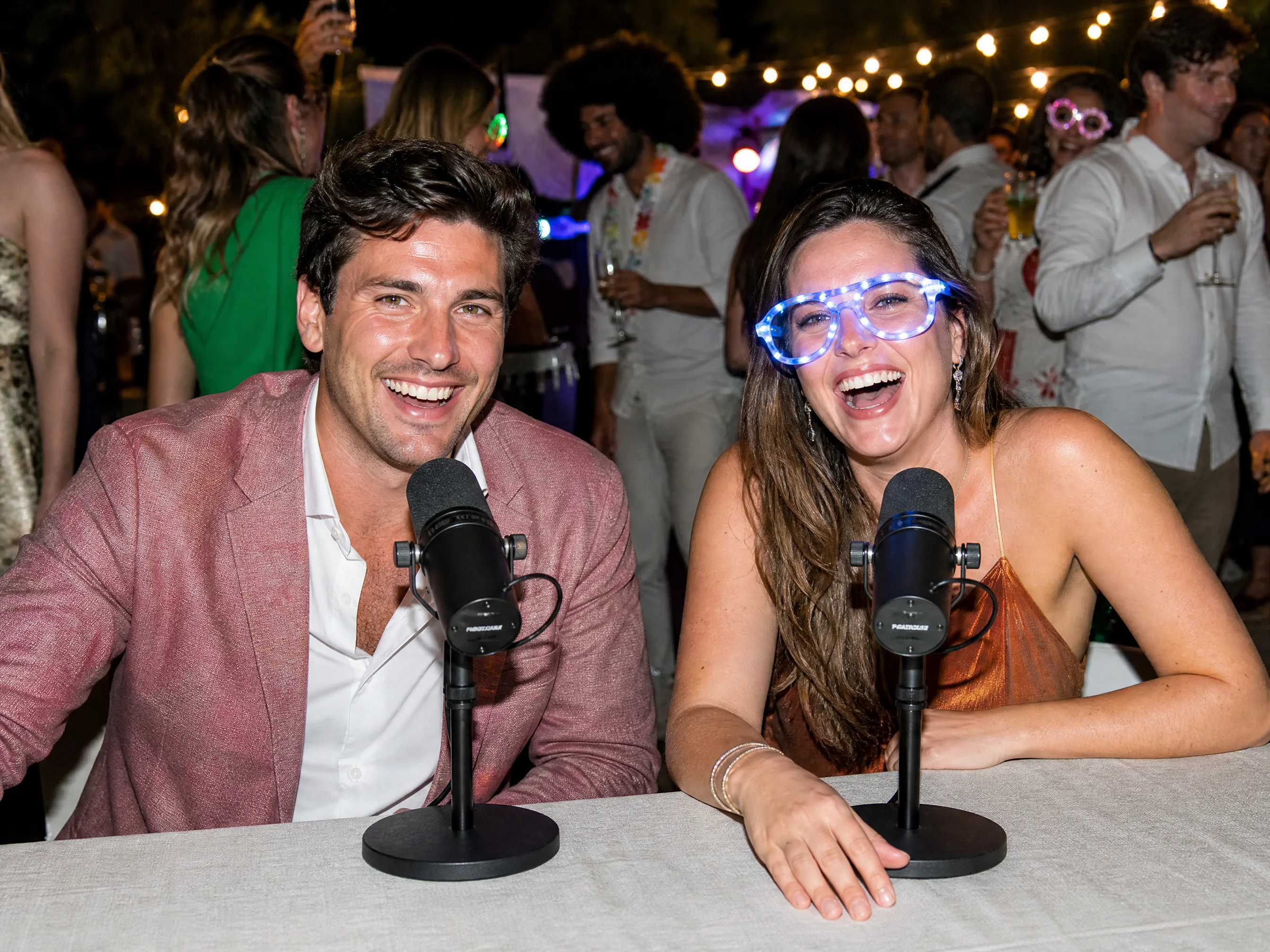
Conceptual process still: chairs pulled in, two mics, a card face-down. Not a named Wedding Podcast Spain wedding.
Seating is pair-shaped on purpose. One person into a phone is a voicemail. Two people across a table is a conversation. That is the whole product difference in one picture.
We will not publish a fake technical rider. Venues should still hear the obvious asks: a quiet-enough corner, a safe cable path, and power. Outdoor service is possible when the corner is sheltered. Indoor service is often simpler after dinner when the garden wind rises.
Recommendation: walk the venue once with the coordinator. Point at a corner guests already pass. Do not hide the table behind a service door.
What guests do, and what they are not asked to do
Guests notice the table. They sit with someone they like. They talk. They leave. That is the guest job. It should feel like sitting down with a drink, not like entering a booth queue with a countdown.
They are not asked to download an app. They are not asked to hold a phone at arm’s length. They are not asked to toast the whole room. They are not asked to speak a second language for the camera. They are not asked to stay until a producer is happy.
Shy guests sit when the invitation is warm and the table looks like the wedding, not like a gadget. Some still will not sit. That is allowed. Forcing a parent into a microphone is a good way to get a stiff thirty seconds and a bad memory of the ask.
Recommendation: have one person in the wedding party mention the table once, kindly. Then let curiosity do the rest.
Prompts that invite stories without a comedy host
Wedding podcast prompts work when they sound like a friend. They fail when they sound like a gameshow. You do not need a host doing stand-up translation between every pair. The card is enough if the question is human.
Useful shapes, not a sacred list from a real shoot. A first memory. A quality you hope they keep. A story from a trip or a kitchen. A wish you would rather say than write.
Avoid prompts that demand a performance. Avoid inside jokes that only six people understand unless those six are the ones sitting down. Avoid legal or medical advice dressed up as humour.
Recommendation: approve the cards with the couple. If a prompt would embarrass a grandparent, cut it.
When it runs
Most destination days have a lull. Cocktail hour is the usual one. People wait for photographs. They want something to do with their hands and their stories. A table near that flow works.
After dinner is another window. Energy is softer. Stories get longer. The dance floor has not taken everyone yet. Open bar later can still work if the corner stays understandable over music. We will not promise a volume battle with a DJ. Place the table away from the speakers.
Share your timeline when you inquire. Coverage length is not a public package on this site. Inventing a slot would be a guess. The honest line is: tell us the day, we confirm what fits.
Recommendation: do not schedule the table against vows or speeches. Those hours already have a job.
What the couple receives
The couple receives professionally recorded video and audio of the guest conversations. That is the public deliverable we can state. We will not invent a highlight length, a USB, a vinyl, or a delivery date.
The files are for you. Voices are identifiable. That makes them personal data under European rules. Sitting down is the guest’s choice. Posting a guest’s face to social channels is a separate decision. Do not treat a hire as a blanket right to publish every uncle.
A wedding film still belongs to your videographer. This is guest conversation, not a replacement crew. Photographers can walk past the table. The table should not steal their ceremony positions.
Recommendation: decide before the day whether any clip may go online. If you are unsure, keep the files private and watch them together later.
How this is not starting a podcast on Spotify
Starting a podcast on Spotify means a show: artwork, a host, a feed, and strangers as an audience. At a reception there is no feed and no launch plan. Guests are not building a brand.
Studio guides talk about quiet rooms. Useful for clean sound. Not a reason to turn the wedding into a studio. The table should still look like Spain: linen, warm light, a corner people want to sit in.
A produced episode with a roaming interviewer is another market. We are not that product and will not quote those prices.
Recommendation: if a vendor’s first question is “what is your show name?”, you are in the wrong conversation.
Check a date with a published package
When the steps make sense, look at Prices — €500 / one hour, €1,200 / three hours, €1,800 / five hours, including 21% IVA — then hold the date. Use Check availability with the date and venue. You can also message WhatsApp or watch the latest setup films on Instagram wedding_podcast_spain.
Planners can use the same form and name themselves in the planner field. There is a short page for that brief at for wedding planners.
What to do next
- Write your date, venue, and guest languages in one note.
- Draft four prompts you would not mind a parent answering.
- Walk the venue plan and mark a quiet-enough corner.
- Send the note through the contact form when you want the day confirmed.
The mechanic is small on purpose. A table, two mics, and time to talk. That is how a wedding podcast works when it is a guest experience, not a show.
Frequently asked questions
How does a wedding podcast work at a destination wedding in Spain?
You confirm the date and venue, set languages and prompts, and place a two-microphone table in a planned corner. Guests sit in pairs, talk, and leave. You later receive professionally recorded video and audio of those conversations.
Will shy guests sit down?
Some will, some will not. An inviting table and human prompts help. Nobody is forced. Kind mention from the wedding party beats a loud announcement.
Can it run indoor or outdoor?
Both can work. Share venue constraints: power, wind, rain cover, and music. We will not invent a rider. Outdoor corners need shelter. Indoor rooms are often simpler after dark.
What do guests have to bring?
Nothing. No app, no headphones, no prepared speech. They bring a person they want to sit with and the voice they already have.
What does the couple receive afterwards?
Professionally recorded video and audio of the guest conversations. Exact packaging and timing are confirmed when you inquire. This page does not invent a kit list.
Is this how I start a podcast on Spotify?
No. This is not a launch guide for a show. There is no feed and no subscriber plan. It is a guest table at your wedding.
Where can I see the short version of the steps?
The scannable sequence lives on how it works. Use that page with a planner. Use this article when you want prompts, placement, and the Spotify distinction.